Short answer: it can work, but no bot can make returns dependable or loss-proof.
The Evidence: Real Account Data from a Live AI Crypto Trading Bot
Rather than starting with theory, here is the strongest screenshot evidence UBI.quest reviewed. It shows a real account window, but it is still not an audited performance report.
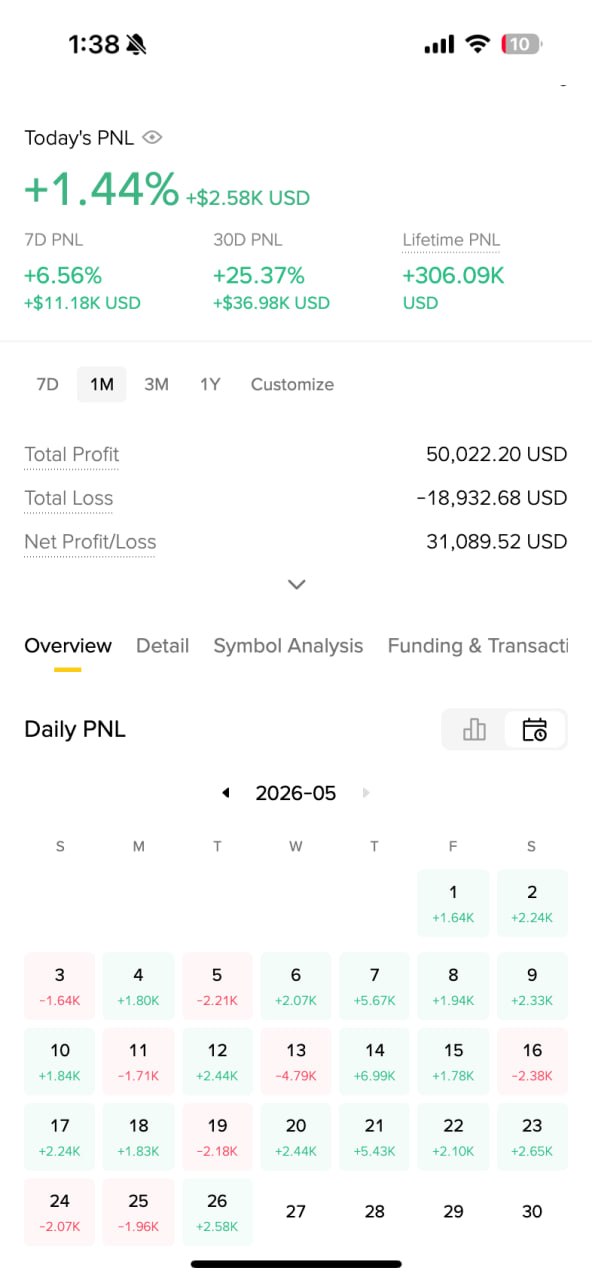
These numbers come from an account screenshot rather than a generic marketing dashboard. The daily PNL calendar for May 2026 includes both positive and negative days. Aurum materials refer to a reported 14% monthly average, but that figure should be treated as historical context, not an expected return.
The lifetime PNL figure shown in the screenshot is meaningful evidence, but one account cannot tell you what a new user will experience. The missing questions still matter: account size, leverage, drawdowns, fees, market regime, and whether similar results appear across many users.
When AI Crypto Trading Works — and When It Doesn't
AI crypto trading is more likely to work when three conditions are met. None of them make gains reliable.
Condition 1: The strategy is professionally managed, not user-configured
The most important variable in crypto bot performance is not the bot's technology — it is the quality of the strategy driving it. Self-directed bots like 3Commas, Cryptohopper, and Pionex give users powerful tools to automate trading. But the strategy itself comes from the user. If the user does not have professional-level trading knowledge, the automation simply executes bad strategy faster and more consistently.
Aurum is presented as a managed service, so the user does not configure strategy parameters in the same way they would with self-directed bots. That can be useful, but it also means users must trust a strategy they cannot fully inspect.
Condition 2: Risk management is systematic and non-negotiable
AI crypto trading fails when a single bad trade undoes weeks or months of gains. This happens when risk management is weak, user-configured, absent, or not suited to the market regime. Aurum uses leverage, and leverage is never a free lunch: it can amplify losses as well as gains.
Condition 3: The bot trades both directions — not just long
Most simple crypto bots are effectively long-only — they buy assets and profit when prices rise. In bull markets, this works well. In bear markets or periods of sharp correction, these bots lose money at the same pace as the underlying assets. Aurum trades perpetual futures, meaning it can take both long and short positions. The result: the bot can generate positive returns in declining markets by being short, and in rising markets by being long. The strategy is not correlated to market direction.
The Honest Part: When AI Crypto Trading Doesn't Work
AI crypto trading does not work when:
- You use a self-directed bot without real trading expertise. The bot will automate your mistakes as efficiently as it would automate your successes.
- You interfere with the system. Pausing the bot during volatility, manually closing positions, or changing parameters in response to short-term results consistently produces worse outcomes than leaving the system alone.
- The strategy is curve-fitted to a specific market period. A bot that was backtested on 2020–2021 bull market data and has never been tested through a bear market or ranging period is not a validated strategy.
- You invest more than you can afford to lose. Crypto futures trading involves leverage. Even well-managed systems have drawdown periods. If the psychological pressure of a drawdown causes you to exit at the worst moment, a good bot will still produce a bad outcome for you.
What the Numbers Actually Mean: Comparing AI Bot Returns
| Bot type | Documented monthly return | Who runs the strategy? | Real account proof? |
|---|---|---|---|
| Aurum (managed) | ~14% / month reported average | Managed strategy | Screenshots, not audit |
| 3Commas (self-directed) | 1–2% / month best case | The user | No live account data |
| Pionex (self-directed) | 1.3–4% / month variable | The user | Marketing data only |
| Cryptohopper (self-directed) | 1–2% / month best case | The user + marketplace | No live account data |
| Manual trading (beginners) | Negative on average | The user | N/A |
Review Aurum With the Risks Visible
The external link is sponsored. Before using it, read the trust policy, use trade-only API permissions, and decide what capital you could afford to lose.
Try Aurum automated trading (sponsored) -> Compare All Bots →Frequently Asked Questions
Does AI crypto trading actually work?
It can work in some periods when strategy, execution and risk controls are strong. It can also lose money. Aurum screenshots reviewed by UBI.quest are useful evidence, but they are not audited performance reports or forecasts.
How much can you realistically make with AI crypto trading?
There is no dependable amount. Scenario tables can show what would happen if a reported monthly rate repeated, but future returns can be lower, negative, interrupted by fees, affected by market conditions, or shaped by user behavior.
What are the risks of AI crypto trading?
The main risks are trading risk, leverage risk, exchange risk, API risk, stablecoin risk, operational risk, and the risk of trusting incomplete evidence. A non-custodial model can reduce withdrawal-access risk, but it does not remove market losses.